The 1MDB Scandal: How $4.5 Billion Vanished in Plain Sight
Use of this article is subject to our Terms of Service.
To understand the sheer scale of the 1Malaysia Development Berhad (1MDB) scandal, you don’t need to look at a bank statement. You just need to watch a movie.
In 2013, The Wolf of Wall Street premiered to critical acclaim. It was a story about excess, greed, and financial fraud. And in a twist too ironic for fiction, the film itself was funded by money stolen from the Malaysian people.
When the credits rolled, a specific name appeared: Red Granite Pictures. This production company was co-founded by Riza Aziz, the stepson of Malaysia’s then-Prime Minister, Najib Razak. The money that paid for Leonardo DiCaprio’s performance didn't come from box office receipts or venture capital. It came from a sovereign wealth fund that was supposed to develop the Malaysian economy.
But Hollywood movies were just the tip of the iceberg.
Between 2009 and 2014, officials at 1MDB and their associates misappropriated approximately $4.5 billion. They bought superyachts, Monet paintings, diamond jewelry for celebrities, and luxury real estate in New York and London. They didn't just steal the money; they flaunted it.
This is not a story about a failed business investment. It is a story about a heist. A heist so massive, so brazen, and so complex that the U.S. Department of Justice called it "kleptocracy at its worst."
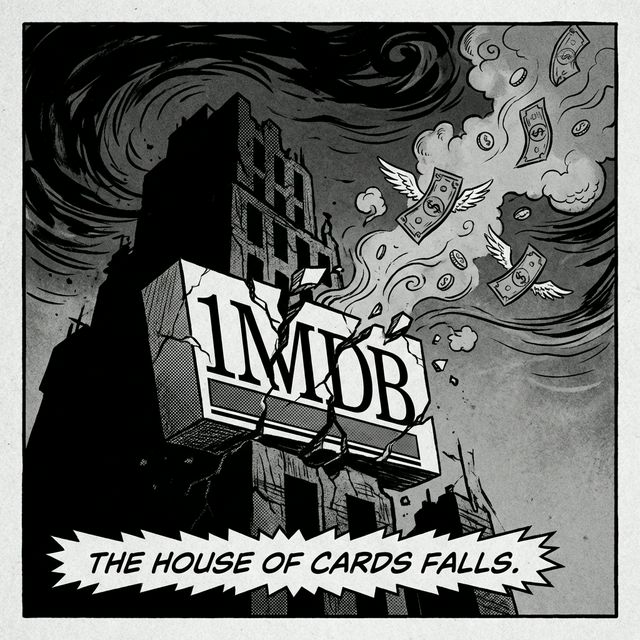
Table of Contents
- The Background: A Fund for the People?
- The Architect: Low Taek Jho
- The Heist: Three Phases of Theft
- The Spending: The Billion-Dollar Party
- The Investigation: Unraveling the Web
- The Money Trail (Interactive)
- The Verdicts: Justice Served?
- The Legacy: A Nation Scarred
- References
The Background: A Fund for the People?
In 2009, Najib Razak became the Prime Minister of Malaysia. One of his first major initiatives was to transform a small, state-level fund called the Terengganu Investment Authority (TIA) into a federal entity.
He renamed it 1Malaysia Development Berhad (1MDB).
The Purpose
On paper, 1MDB was a strategic development company, wholly owned by the Government of Malaysia. Its mission was to drive sustainable economic development by forging global partnerships and promoting foreign direct investment. It was supposed to build energy plants, develop a new financial district in Kuala Lumpur (the Tun Razak Exchange), and improve the lives of ordinary Malaysians.
The Structure
Unlike other sovereign wealth funds that are typically funded by national surplus (like oil revenue), 1MDB was funded by debt. The fund borrowed billions of dollars through bond issuances, backed by the Malaysian government. This meant that if the fund failed, the Malaysian taxpayers would be on the hook.
Najib Razak didn't just oversee the fund as Prime Minister; he also served as the Chairman of 1MDB’s Board of Advisors. This dual role gave him unprecedented control over the fund’s operations and finances.
But there was another figure in the shadows, one who held no official position at 1MDB but pulled all the strings.
The Architect: Low Taek Jho
Jho Low.
To the party scene in New York and London, he was a mysterious Asian billionaire who bought champagne by the crate/truckload and partied with Paris Hilton. To the bankers at Goldman Sachs, he was the gatekeeper to the Malaysian Prime Minister.
Born in Penang, Malaysia, ensuring a wealthy upbringing, Low attended the elite Harrow School in London and later the Wharton School at the University of Pennsylvania. It was at Harrow that he befriended Riza Aziz, Najib Razak's stepson. This connection would become the key to the vault.
Low helped set up the TIA, the precursor to 1MDB. When it became 1MDB, valid concerns were raised about his role. He was never officially employed by 1MDB. He wasn't a board member. He wasn't a consultant. Yet, as the U.S. Department of Justice (DOJ) would later allege, he was the mastermind behind the scheme, directing the flow of billions of dollars into accounts he controlled.
"Jho Low is the 1MDB mastermind," said former CEO Shahrol Azral Ibrahim Halmi during later court testimonies. "He was the one who gave the instructions."
The Heist: Three Phases of Theft
The looting of 1MDB wasn't a single event. It was a sustained campaign of theft executed in three distinct phases, each more complex than the last.
Phase 1: The "Good Star" Phase (2009-2011)
The Premise: 1MDB entered into a joint venture with a private Saudi Arabian oil services company called PetroSaudi International. 1MDB was to invest $1 billion in cash, and PetroSaudi would contribute oil assets.
The Reality: Of the $1 billion 1MDB invested, only $300 million went to the joint venture account. The remaining $700 million was diverted to a Swiss bank account held by a Seychelles-registered company called Good Star Limited.
Who owned Good Star Limited? Not PetroSaudi. It was owned by Jho Low.
Officials at 1MDB misled banks, claiming Good Star was a subsidiary of PetroSaudi. It wasn't. The money was gone instantly.
Phase 2: The "Aabar BVI" Phase (2012)
The Premise: 1MDB needed to raise capital to buy power plants. Goldman Sachs was hired to arrange bond issuances totaling $3.5 billion.
The Reality: Collusion with officials from IPIC (an Abu Dhabi sovereign wealth fund) allowed the thieves to set up a fake fake entity. They created a company in the British Virgin Islands called "Aabar Investments PJS Limited" (Aabar BVI).
It had a name almost identical to the legitimate subsidiary of IPIC, "Aabar Investments PJS."
When the bond money came in, 1MDB transferred approximately $1.367 billion to the fake Aabar BVI as a "security deposit." From there, the money flowed to accounts controlled by Low and his associates.
Phase 3: The "Tanore" Phase (2013)
The Premise: Another joint venture, this time with Abu Dhabi, meant to develop the Tun Razak Exchange. Goldman Sachs raised another $3 billion in bonds.
The Reality: Within days of the bond raise, over $1.26 billion was diverted to a bank account in Singapore held by Tanore Finance Corporation.
Tanore had no legitimate connection to the project. It was a shell company. And this is where the money started flowing back to Malaysia—specifically, into the personal bank accounts of "Malaysian Official 1."
The Spending: The Billion-Dollar Party
What do you do with $4.5 billion? You spend it. And you spend it fast.
The spending spree embarked upon by Jho Low and his associates is legendary for its excess. It serves as the most visible evidence of the fraud.
The Real Estate
They bought:
- The Park Lane Hotel in New York City.
- A $50 million penthouse at the Time Warner Center in New York.
- A $35 million mansion in Beverly Hills.
- A $7 million townhouse in London.
The Toys
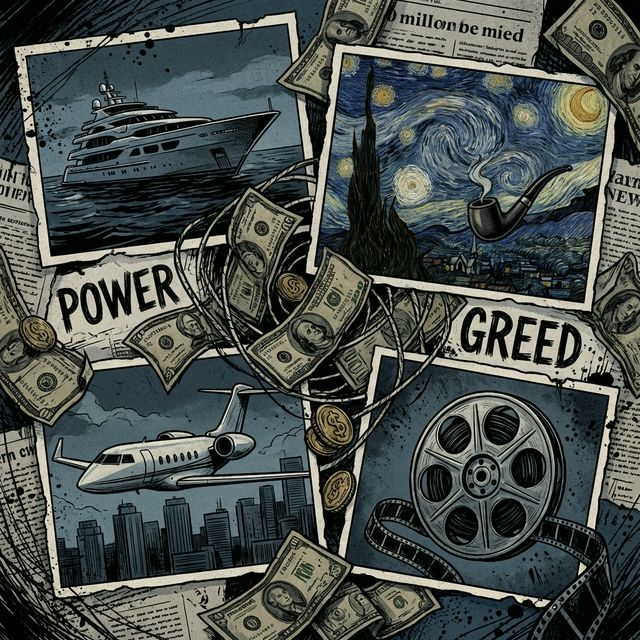
Jho Low commissioned the Equanimity, a 300-foot superyacht costing $250 million. It had a helicopter pad, a swimming pool, and a cinema.
They bought a Bombardier Global 5000 private jet for $35 million.
The Arts
They became major players in the high-end art market, purchasing works by Van Gogh, Monet, Picasso, and Basquiat.
- Van Gogh's "La maison de Vincent à Arles": $5.5 million.
- Monet's "Nymphéas": $57.5 million.
- Basquiat's "Dustheads": $48.8 million.
Other "Investments"
- Gambling: Jho Low and associates spent millions at the tables in Las Vegas.
- Jewelry: Need a gift? How about $27 million for a pink diamond necklace for the wife of "Malaysian Official 1"? Or a $3.2 million Picasso painting for Leonardo DiCaprio?
And, of course, they funded Red Granite Pictures, which produced The Wolf of Wall Street, Daddy's Home, and Dumb and Dumber To.
The Investigation: Unraveling the Web
The scheme relied on secrecy, but in the digital age, secrets are hard to keep.
The Whistleblowers
Sources began leaking emails and documents. Sarawak Report, an investigative blog run by Clare Rewcastle Brown, published verified documents showing the money trail from 1MDB to Jho Low's Good Star Limited. The Wall Street Journal followed with bombshell reports tracing nearly $700 million directly into Najib Razak’s personal bank accounts.
The Domestic Crackdown
In Malaysia, the response was swift—but not against the criminals. It was against the investigators.
- The Attorney General who was preparing charges against Najib was abruptly fired.
- The investigative task force was disbanded.
- Newspapers were suspended.
- Critics were arrested.
- Najib claimed the money in his account was a "donation" from a Saudi prince.
The International Hammer
While Najib could control institutions inside Malaysia, he couldn't control the United States.
In July 2016, the U.S. Department of Justice (DOJ) announced the Kleptocracy Asset Recovery Initiative's largest single action in history. They filed civil forfeiture complaints seeking to recover more than $1 billion in assets associated with the 1MDB conspiracy.
"The Malaysian people were defrauded on an enormous scale," said Deputy Attorney General Andrew McCabe. "The Department of Justice will not allow the U.S. financial system to be a conduit for corruption."
The Money Trail
How exactly did the money move? Follow the path of the funds in the "Tanore" phase, one of the most direct evidence trails of the scandal.
The Ink Dries on $3 Billion
March 19, 2013. Singapore.
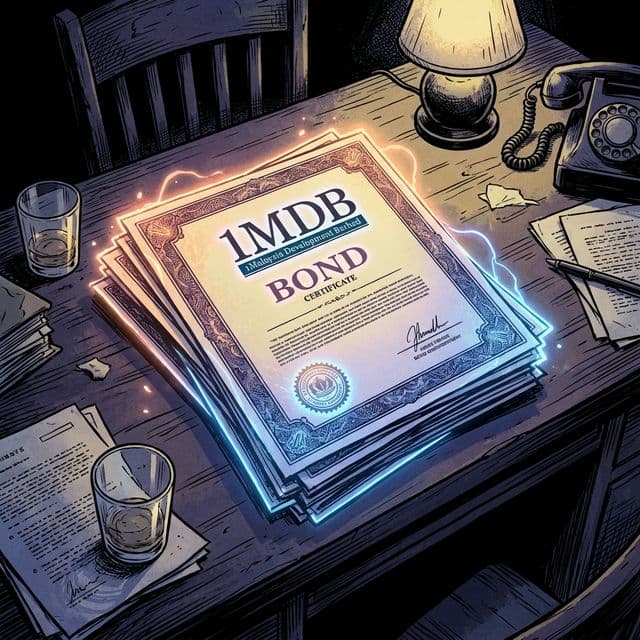
In a glass-walled conference room overlooking Marina Bay, champagne corks pop. Goldman Sachs has just closed the deal of the decade—a $3 billion bond issuance for Malaysia's sovereign wealth fund.
The bankers are celebrating. They've earned $600 million in fees—nearly 10% of the total. An unheard-of cut. But nobody's asking questions. Not yet.
The official purpose? Building the Tun Razak Exchange—a gleaming new financial district that will transform Kuala Lumpur into Asia's next banking hub.
Three billion dollars. Enough to build 60 hospitals. Or 300 schools. Or change the lives of millions.
The money will never get there.
24 Hours. $1.26 Billion. Gone.
The celebration hasn't even ended when the first wire transfer is initiated.
At 9:47 AM the next morning, a bank clerk in Singapore processes an unusual request. $1.26 billion—more than a third of the entire bond issuance—is to be moved immediately.
The destination? Not the development fund. Not the joint venture account. A company called Tanore Finance Corporation.
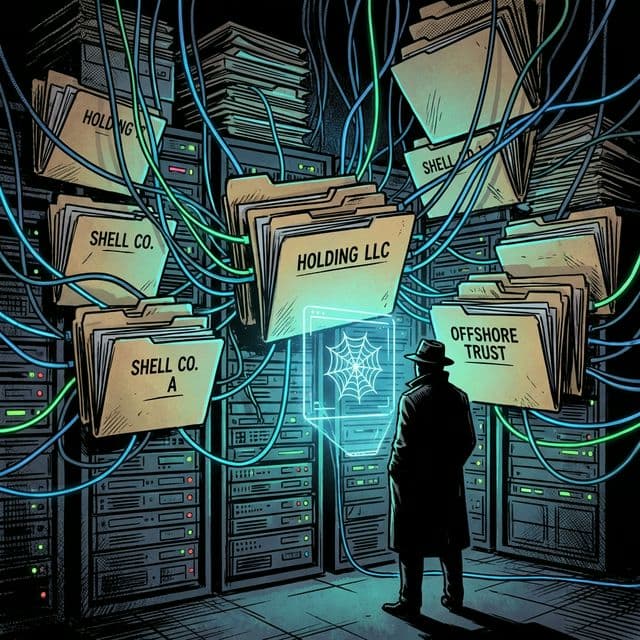
The clerk hesitates. Tanore has no website. No employees. No physical address. It exists only as a name on a piece of paper in the British Virgin Islands.
But the authorization codes check out. The transfer goes through.
In less than 24 hours, the largest financial crime in Malaysian history has begun.
Into the Prime Minister's Pocket
March 21-25, 2013. Kuala Lumpur.
The money doesn't rest in Tanore. It's already moving again—this time, across the South China Sea to Malaysia.
Over four days, a single AmBank account receives wire after wire. $681 million in total. Each transfer carefully structured to avoid automatic flags.
In U.S. court documents, the account holder is identified only as 'Malaysian Official 1.' The name is redacted. The identity, an open secret.
It was the Prime Minister of Malaysia. The man sworn to protect the people's wealth.
Najib Razak now has $681 million in his personal bank account.
In a nation where the average monthly income is $800, it would take an ordinary Malaysian 70,000 years to earn this much.
Diamonds for the First Lady
Meanwhile, in New York City, Jho Low is shopping.
At Lorraine Schwartz, the jeweler to the stars, his eye catches something extraordinary: a 22-carat pink diamond. One of the rarest gems on Earth. Only a handful exist at this size.
The price tag: $27.3 million.
Low doesn't blink. The money is wired. The diamond is set into an elaborate necklace.
The gift? For Rosmah Mansor—the Prime Minister's wife. A woman already known for her collection of Birkin bags and designer shoes.
This single necklace could have funded scholarship programs for 50,000 students. Could have built a dozen rural clinics. Could have provided clean water to villages that still have none.
Instead, it hangs around the neck of the most powerful woman in Malaysia.
The Trail They Couldn't Erase
August 2013.
Someone is getting nervous. The Wall Street Journal is asking questions. Investigators in Switzerland have opened files. The walls are closing in.
A decision is made: return the money. Make it look like nothing happened.
$620 million is transferred out of Najib's AmBank account, back through the labyrinth of shell companies.
But here's what the schemers didn't understand about the modern financial system:
Every wire transfer leaves a trace. Every bank keeps records—for years, for decades. Every digital transaction is logged, timestamped, and stored on servers in jurisdictions they don't control.
The evidence that will eventually bring down a Prime Minister, bankrupt a Wall Street titan, and trigger the largest kleptocracy investigation in history...
...is already sitting in bank servers from Singapore to New York, waiting to be found.
The Verdicts: Justice Served?
The 1MDB scandal brought down a government and led to historic convictions.
The Fall of Najib Razak
In May 2018, the Malaysian people voted for change. The Barisan Nasional coalition, which had ruled for 61 years, was defeated. The new government immediately reopened the 1MDB investigations. Police raided Najib’s properties, seizing cash, jewelry, and luxury handbags worth up to $273 million. It was the largest seizure in Malaysian history.
The Trials:
- December 2025: The Kuala Lumpur High Court convicted Najib Razak on 25 charges of abuse of power and money laundering related to 1MDB. He was sentenced to 15 years in prison and fined RM11.3 billion ($2.8 billion).
- This was in addition to a previous conviction in 2020 related to SRC International (a 1MDB unit), for which he was already serving time.
Justice Datuk Collin Lawrence Sequerah ruled that the defense's claim of an "Arab donation" was untenable and that the evidence was "cold, hard, and incontrovertible."
The Bankers
Goldman Sachs paid a heavy price for its role.
- In 2020, the bank entered into a Deferred Prosecution Agreement (DPA) with the U.S. DOJ.
- Goldman agreed to pay over $2.9 billion in penalties to global regulators, including the U.S., UK, Singapore, and Hong Kong.
- They also paid a $3.9 billion settlement to the Malaysian government.
- Tim Leissner, the former chairman of Goldman Sachs in Southeast Asia, pleaded guilty to conspiracy to launder money and violate the FCPA.
- Roger Ng, another Goldman banker, was convicted by a U.S. jury and sentenced to 10 years in prison (later returned to Malaysia for prosecution).
The Fugitive
And Jho Low?
He remains at large. Despite an Interpol Red Notice and warrants for his arrest in multiple countries, he has evaded capture. Reports in 2025 placed him in Shanghai, allegedly living under an alias. He continues to deny all wrongdoing, claiming he is a victim of political persecution.
The Legacy: A Nation Scarred
The 1MDB scandal changed Malaysia forever. It shattered the invincibility of the ruling elite and proved that corruption could be challenged at the ballot box.
It also changed the financial world. Compliance regulations tightened globally. "Know Your Customer" (KYC) rules became more rigorous. The scandal serves as a case study in business schools and law enforcement academies worldwide—a warning of what happens when checks and balances fail completely.
The U.S. DOJ has successfully recovered and returned over $1.4 billion in stolen assets to the people of Malaysia. The superyacht Equanimity was seized, sold, and renamed. The Monet and Van Gogh paintings were auctioned off.
But the debt remains. The Malaysian public will be paying off the interest on 1MDB's bonds for years to come. The true cost wasn't just the money; it was the lost opportunity for a developing nation.
As for the "Wolf of Wall Street"? The rights to the film were forfeited to the U.S. government. In the end, the story of a fraudster, funded by fraud, became property of the state.
References
- U.S. Department of Justice. (2016). United States Seeks to Recover More Than $1 Billion Obtained from Corruption Involving Malaysian Sovereign Wealth Fund. Press Release.
- U.S. Department of Justice. (2020). Goldman Sachs Charged in Foreign Bribery Case and Agrees to Pay Over $2.9 Billion. Press Release.
- Kuala Lumpur High Court. (2025). Public Prosecutor v. Najib Razak. Judgment Summary.
- Securities and Exchange Commission. (2019). Tim Leissner Settles FCPA Charges. Litigation Release.
- Federal Bureau of Investigation. (2017). 1MDB Asset Seizure. Official Statement.
- Sarawak Report. (2015). Heist of the Century. Investigative Series.
- The Wall Street Journal. (2015). Investigators Believe Money Flowed to Malaysian Leader Najib’s Accounts.
- Malaysian Ministry of Finance. (2021). 1MDB Asset Recovery Update. Official Report.