How to Read Candlestick Charts: The Ultimate Beginner's Guide to Mastering Market Sentiment (2025)
The Art and Science of Reading Candlestick Charts: A Complete Masterclass
If you’ve ever glanced at a financial terminal—be it a professional Bloomberg terminal, a sleek TradingView dashboard, or even a simple crypto exchange mobile app—you’ve been met with a rhythmic, pulsing forest of red and green vertical bars. These are Japanese Candlestick Charts.
To the untrained eye, they look like a random heartbeat monitor for a chaotic patient. But to a seasoned trader, these charts are more than just data points. They are a visual representation of the eternal struggle between human greed and human fear. They are a "language" that allows you to hear what the market is whispering (or screaming) before the news headlines ever catch up.
Whether you're looking to trade stocks, forex, or digital assets like Bitcoin, the ability to read candlesticks is the single most important skill you can acquire. It is the "source code" of the markets. In this comprehensive guide, we are going to break down everything from the basic anatomy of a candle to advanced pattern recognition and the deep psychological forces that make these shapes appear.
Part 1: The Soul of the Market – Why Candlesticks Matter
Before we get into the technical "how-to," we need to understand the "why."
In the financial world, there are several ways to visualize price. You have Line Charts, which simply connect the closing prices over a period of time. You have Bar Charts (OHLC), which provide more data but can be visually cluttered. And then you have Candlesticks.
Why did candlesticks win the battle for dominance? Because they provide the highest information density while remaining visually intuitive.
The Visual Narrative
A line chart is like reading a sports score after the game is over. "Team A won 2-1." It tells you the outcome, but it tells you nothing about the game. Was it a blowout until the last minute? Was there a red card? Did the underdog almost stage a miracle comeback?
A candlestick chart is the live play-by-play. It shows you the intensity of the struggle. It shows you the moments when the buyers almost lost everything, only to be saved by a surge of capital at the last second. It shows you the points where the price reached a new all-time high, only to be rejected by sellers waiting in the shadows.
When you look at a candlestick, you aren't just looking at a price of $150.25. You are seeing the conviction of the people behind that price.
Part 2: The Rice Trader’s Secret – A Brief History
The history of candlesticks is as fascinating as the charts themselves. While most Western technical analysis tools were developed in the 20th century, candlesticks have been around for nearly 300 years.
In the mid-1700s, a legendary rice trader named Munehisa Homma operated in the Dojima Rice Exchange in Osaka, Japan. Homma realized something revolutionary for his time: while supply and demand were important for the price of rice, the markets were ultimately driven by the emotions of the traders.
Homma began tracking the price movements of rice on a daily basis using candle-like shapes. He would record the opening price, the highest price, the lowest price, and the closing price. By doing this, he could see patterns emerging. He realized that the market had a "climate"—sometimes it was sunny and optimistic (bullish), and sometimes it was cold and fearful (bearish).
Homma’s success was so profound that it was said he won 100 consecutive trades. He eventually became a financial advisor to the Japanese government and was given the status of a Samurai. His insights were later codified into the "Sakata Rules," which form the basis of modern candlestick patterns.
It wasn't until the late 1980s that Steve Nison, an American analyst, discovered these techniques while working with Japanese traders. He brought them to the West, and the rest is history. Today, Homma's 300-year-old "emotions monitor" is used by AI-powered hedge funds and retail day traders alike.
Part 3: Anatomy of a Candlestick – Breaking Down the OHLC
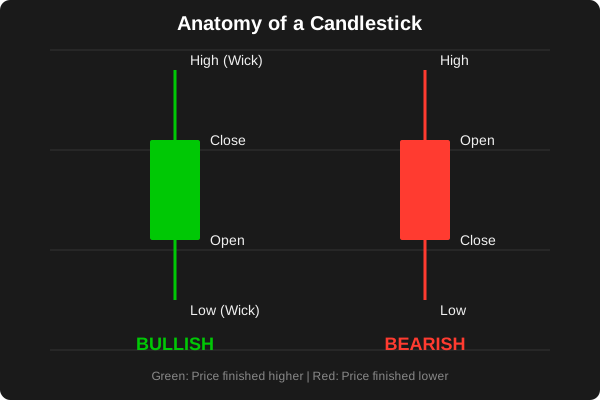
To read the language, you must first learn the alphabet. Every candlestick represents a specific "session" or period of time. This could be 1 minute, 1 hour, 1 day, or 1 week. Regardless of the duration, every candle is built from four crucial price points:
1. The Open
The Open is the price at the very first second of the session. It represents the starting point of the battle. The relationship between the previous candle's close and this candle's open can often tell you if there was "overnight" news or a sudden shift in sentiment.
2. The High
The High is the maximum price reached during the session. It represents the uttermost limit of the Bulls' power. It is the point where buyers were finally exhausted, or where sellers deemed the price so expensive that they stepped in with overwhelming force.
3. The Low
The Low is the minimum price reached during the session. It represents the maximum reach of the Bears' power. It shows where the sellers were finally stopped by a "floor" of buyers who found the price too attractive to pass up.
4. The Close
The Close is the final price of the session. This is the most important data point. The Close tells us who won the battle. If the Close is near the High, the buyers won convincingly. If it’s near the Low, the sellers are in total control.
The Real Body vs. The Wicks
- The Real Body: The colored, thick part of the candle. It shows the range between the Open and the Close. If the body is large, it indicates strong momentum. If the body is small, it indicates a lack of conviction.
- Green/White Body: Bullish (Close > Open)
- Red/Black Body: Bearish (Close < Open)
- The Wicks (Shadows): The thin lines extending above and below. They represent rejection. A long wick means the price went there, but it couldn't stay there.
Part 4: The Psychology of Price Action – Reading the Story
Now that we know the parts, let's look at how they tell a story. If you see a candle with a tiny body and massive wicks on both sides, what is the market telling you?
It’s telling you that both the Bulls and the Bears tried to take control, but both failed. It’s a sign of extreme indecision. Traders are waiting for a piece of news, or they are unsure about the current valuation. This is the calm before the storm.
Conversely, if you see a giant green candle with almost no wicks (a "Marubozu"), it means the buyers took control from the very first second and never let go. They were so aggressive that they didn't even allow a minor dip. This is pure conviction.
The Concept of "Rejection"
One of the most powerful concepts in chart reading is "Upper Wick Rejection." Imagine a stock is rising. It hits $100. Suddenly, a massive wick forms above. This means that as soon as the price hit $100, a huge number of sellers "dumped" their shares. The market voted $100 as "too expensive."
If you see this happen multiple times at the same price, you have found a Resistance level—a ceiling that the market isn't ready to break through yet.
Part 5: Essential Bullish Reversal Patterns (The Buying Signals)
A reversal pattern is a sign that the current trend (usually a downtrend) is ending. Think of it as a car slamming on the brakes before reversing direction.
1. The Hammer
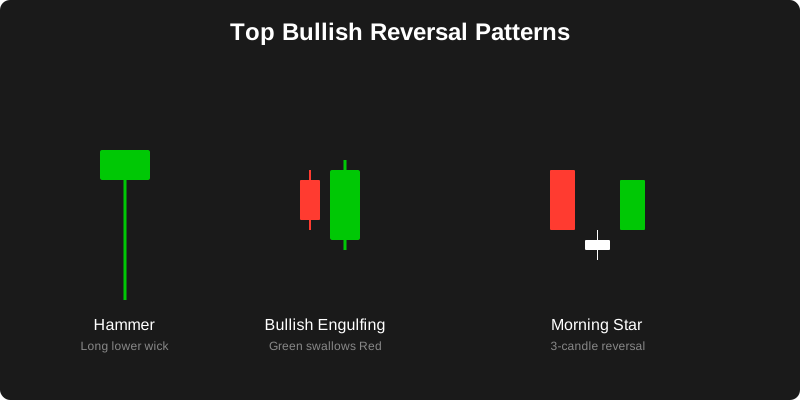
The Hammer is perhaps the most iconic bullish sign. It appears at the bottom of a downtrend. It has a small body and a long lower wick.
- The Story: The market opened and immediately crashed. Sellers were jubilant. But then, midway through the session, the "smart money" stepped in. They bought everything in sight, driving the price all the way back up to where it started.
- The Signal: The bears tried their best to kill the trend, and they failed. The "floor" has been found.
2. Bullish Engulfing
This involves two candles. Day 1 is a small red candle. Day 2 is a large green candle that completely covers (engulfs) Day 1.
- The Story: On Day 1, the bears were in control, but they were weak. On Day 2, the bulls didn't just win; they annihilated the bears. They wiped out all of yesterday's progress in a single session.
- The Signal: A massive shift in momentum. Buyers are now aggressive.
3. The Morning Star
A three-candle "story":
- Dread: A long, scary red candle.
- Confusion: A tiny candle (indecision) that gaps down.
- Hope: A long green candle that recovers more than half of the first red candle.
- The Signal: The panic is over. The "star" (the middle candle) represents the turning point.
4. Piercing Line
Similar to the Engulfing pattern, but the green candle only recovers about 50-70% of the previous red candle.
- The Signal: It’s a "budget" engulfing pattern. Still bullish, but requires confirmation from the next candle.
Part 6: Essential Bearish Reversal Patterns (The Selling Signals)
These patterns appear at the top of an uptrend. They warn you that the "Easy Money" has been made and it’s time to protect your profits.
1. The Shooting Star
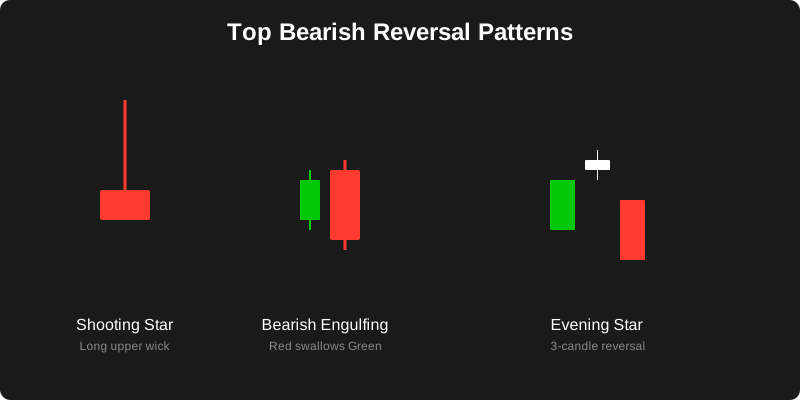
The evil twin of the Hammer. Small body at the bottom, long wick at the top.
- The Story: Buyers pushed the price to a new high. They were celebrating. Then, out of nowhere, a wave of selling hit. The price collapsed back to the starting point.
- The Signal: The "ceiling" has been hit. Buyers are exhausted.
2. Bearish Engulfing
A small green candle followed by a massive red candle.
- The Story: The bulls were having a nice, quiet day until the bears showed up with a sledgehammer. The bears didn't just sell; they dominated the entire session.
- The Signal: Warning! Trend reversal is imminent.
3. The Evening Star
The opposite of the Morning Star.
- Euphoria: Long green candle.
- Stall: Tiny body (indecision).
- Collapse: Long red candle.
- The Signal: The sun is setting on this uptrend. Time to exit.
4. Dark Cloud Cover
A bearish reversal pattern where a red candle opens above the previous green candle's high but closes well into the green candle's body.
- The Story: "Optimism meets Reality." The market gapped up, everyone was bullish, but by the end of the day, reality set in and the price tumbled.
Part 7: Neutral Patterns – The Logic of Indecision
Sometimes the best thing to do in the market is nothing. Neutral patterns tell you that the tug-of-war is tied.
The Doji Family
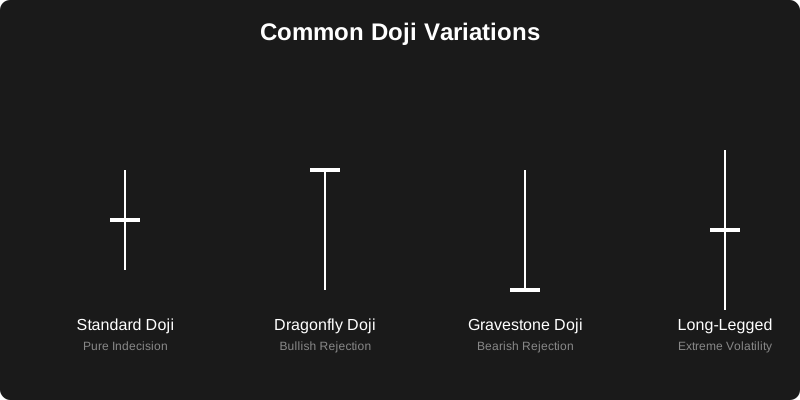
A Doji occurs when the Open and Close are exactly (or nearly) the same. It looks like a plus sign or a cross.
- Standard Doji: Pure "I don't know." The market is waiting for news.
- Dragonfly Doji: T-shaped. Sellers tried to push price down but buyers rejected it. Highly bullish if it appears at support.
- Gravestone Doji: Inverted T-shaped. Buyers tried to push price up but sellers rejected it. Highly bearish if it appears at resistance.
- Long-Legged Doji: Large wicks on both sides. High volatility, but zero progress.
Spinning Tops
Small bodies with medium wicks. They represent a "breather." If you see a series of spinning tops in an uptrend, it means the trend is losing steam. It’s not a reversal yet, but it’s a warning to tighten your stop-losses.
Part 8: Context is Everything – The "Where" Matters More Than the "What"
This is the most critical lesson in this guide. A candlestick pattern without context is just a geometric shape.
If you see a Hammer in the middle of a messy, sideways market, it is worthless. It’s just "noise." However, if you see a Hammer form right on a Major Support Level, it is a high-ranking signal.
1. Support and Resistance
- Support: A price level where a downtrend tends to pause due to a concentration of demand (buying).
- Resistance: A price level where an uptrend tends to pause due to a concentration of supply (selling).
The Rule: Look for Bullish patterns at Support. Look for Bearish patterns at Resistance.
2. Moving Averages
Many traders use the 200-day Moving Average as a "line in the sand." If price pulls back to the 200-day MA and forms a Morning Star, you have "confluence"—the chart is telling you the same thing from two different angles.
3. Volume Confirmation
Candlesticks tell you the "Price Action," but Volume tells you the "Conviction."
- An Engulfing pattern on low volume is often a trap (a "bull trap" or "bear trap").
- An Engulfing pattern on high volume is a genuine shift in institutional sentiment.
Part 9: Multi-Timeframe Analysis – Seeing the Big Picture
A common mistake beginners make is looking only at one timeframe (e.g., the 5-minute chart). A 5-minute chart might show a "Bearish Engulfing" pattern, suggesting you should sell. But if you zoom out to the Daily chart, you might see that the price is actually in a massive uptrend and just hitting a minor support level.
The Pro Tip:
- Check the Weekly chart for the major trend.
- Check the Daily chart for the medium-term setup.
- Use the 1-Hour or 15-Minute chart to time your entry using candlestick patterns.
Part 10: The Psychological Trap – FAKE OUTS
The market is designed to take money from the impatient. Sometimes, a "perfect" Bullish Engulfing pattern will form, you buy, and then the price immediately crashes. This is called a Fake Out.
Why does it happen? Large institutions (the "Whales") often need liquidity to sell their massive positions. They might intentionally push the price up to create a "Bullish Engulfing" pattern, which lures in retail traders who buy. Once the retail traders have bought, the Whales sell into that buying pressure, causing the price to collapse.
How to avoid it: Wait for Confirmation. Don't just buy the second the candle closes. Wait for the next candle to break the high of the pattern. This proves that there is "follow-through" buying.
Part 11: Common Pitfalls and How to Avoid Them
- The "Isolation" Error: Trading a pattern without looking at the trend or support/resistance.
- Ignoring the Timeframe: Thinking a 1-minute Hammer is as strong as a Weekly Hammer.
- Lack of Patience: Entering a trade before the candle closes. A candle can look like a Hammer with 10 seconds left, but if a big sell order comes in, it could close as a long red bar. Always wait for the close.
- No Risk Management: Thinking that a candlestick pattern is a "guarantee." It’s an edge, not a certainty. Always use a Stop-Loss.
Part 12: Conclusion – Your Path to Mastery
Reading candlestick charts is not a magic trick. It is a form of visual literacy.
By learning these patterns, you are learning to read the collective mind of millions of traders. You are seeing the struggle between the fear of missing out (FOMO) and the fear of losing everything.
The Next Steps for You:
- Paper Trade: Don't use real money yet. Open a demo account.
- Backtest: Go back in history on a chart like Apple (AAPL) or Bitcoin (BTC). Find 50 "Hammers." How many of them actually resulted in a price increase?
- Focus on One: Master one pattern at a time. Become the "Hammer Expert" before you try to trade everything.
Mastering the markets takes years, but the first step is always the same: Learning to see. Once you see the story behind the candle, you will never look at a chart the same way again.
Frequently Asked Questions (FAQ)
1. Which candlestick pattern is the most accurate?
Statistical studies often point to the Bullish and Bearish Engulfing patterns as having the highest win rates, especially when they occur on the Daily (D1) timeframe at major support/resistance levels.
2. Can I use candlesticks for Day Trading?
Absolutely. Day traders typically use the 5-minute, 15-minute, and 1-hour timeframes. However, be aware that patterns on shorter timeframes are more prone to "noise" and false signals.
3. Do I need special software to see these charts?
Most modern brokers provide candlestick charts for free. TradingView is the gold standard for web-based charting, while MetaTrader is popular for Forex traders.
4. Why are some candles different colors?
Red and Green are standard, but you can customize them. Some traders prefer White (Bullish) and Black (Bearish). The color is simply a visual aid to quickly distinguish if the close was higher or lower than the open.
5. What is a "Marubozu"?
A Marubozu is a candle with a large body and no wicks. A Green Marubozu means buyers were in control from the open to the close without any pullback. It is a sign of extreme strength.
Disclaimer: Trading financial markets involves significant risk of loss. The information in this guide is for educational purposes only. Always consult with a certified financial advisor before making investment decisions.