Trading Psychology: Measuring the Behavioral Edge
Trading Psychology: Measuring the Behavioral Edge
You can give two traders the exact same strategy, the same capital, and the same market signals. One will become a millionaire; the other will go broke.
The difference is not in the charts. It is between the ears.
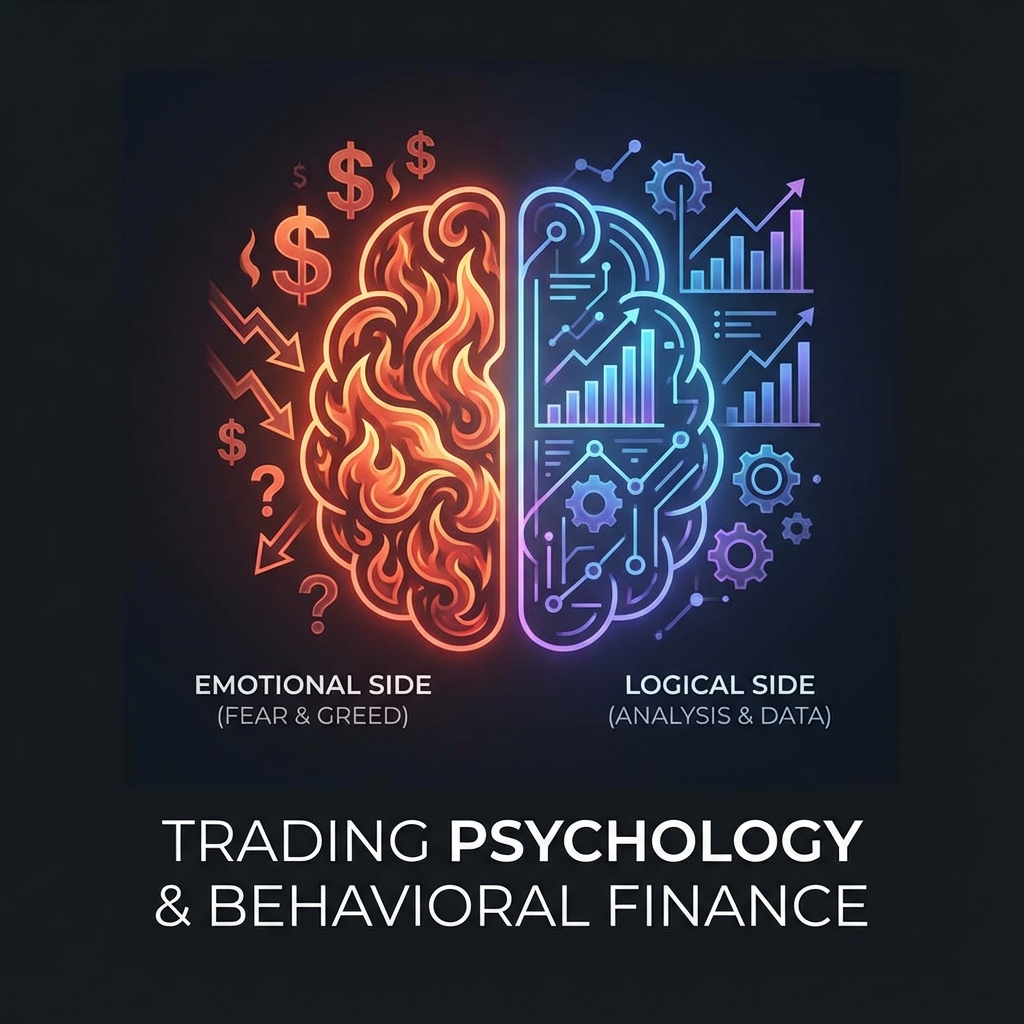
Trading Psychology refers to the emotions and mental states that dictate success or failure in trading securities. Acknowledging your own irrationality is the first step to conquering the markets.
1. The Reptile Brain vs. The Trader
From an evolutionary standpoint, humans are wired terribly for trading.
- Survival Instinct: When threatened (losing money), we freeze or fight (hold losing trades hoping they come back).
- Resource Hoarding: When we find food (making money), we want to take it immediately (selling winners too early).
In trading, you must do the opposite: Cut losses quickly (flight) and let winners run. You have to fight millions of years of evolution.
2. Common Cognitive Biases
A. Loss Aversion
Studies (Kahneman & Tversky) show that the pain of losing $1,000 is psychologically twice as intense as the pleasure of gaining $1,000.
- Symptom: Holding a "bag" (losing position) for months because "it's not a loss until I sell."
- Cure: Hard stop losses. Accept the loss as the "Cost of Doing Business" (CODB).
B. Confirmation Bias
Seeking out information that supports your existing belief and ignoring contradicting evidence.
- Symptom: You are long Bitcoin, so you only follow bullish influencers and ignore regulatory news warnings.
- Cure: Actively seek out the "Bear Case." Invert the thesis. "What would make me wrong?"
C. Recency Bias
Giving too much weight to recent events.
- Symptom: Buying the top after a 5-day green streak because "it looks so strong," or being too scared to buy the bottom after a crash.
- Cure: Zoom out. Look at long-term averages.
D. Gambler's Fallacy
Believing that a streak must end. "It's been red for 8 candles; the next one must be green."
- Reality: The market has no memory. The probability is independent.
3. The Cycle of Market Emotions
- Optimism: "I think I'll buy some of this."
- Excitement: "It's going up! I made a smart choice."
- Euphoria: "I'm a genius. I'm going to leverage up." (Maximum Financial Risk)
- Anxiety: "It's pulling back a bit, but it will bounce."
- Denial: "I'm a long term investor now."
- Panic: "It's dropping too fast! Get me out!"
- Capitulation: "I'm selling everything. I'll never trade again." (Maximum Financial Opportunity)
- Depression: "I lost so much money."
- Hope: "Maybe it's recovering..." (Cycle repeats).
4. Building the "Trader's Mindset"
The Probability Thinker
Mark Douglas, author of Trading in the Zone, argues that you must think in probabilities, not certainties.
- Bad Mindset: "This trade will work." (If it fails, you are emotionally damaged).
- Good Mindset: "This setup has a 60% chance of working. If this one is part of the 40% loss, that's fine. The next one will pay."
The Discipline of the Journal
You cannot improve what you do not measure.
- Log every trade: Entry, Exit, PnL.
- Log your EMOTION: "I entered early because I had FOMO." "I moved my stop loss because I was scared."
- Reviewing these notes reveals your behavioral leaks.
5. Practical Techniques for Emotional Control
- Reduce Size: If your heart is racing, your position size is too big. Trade so small that the loss is boring.
- Walk Away: If you lose 3 trades in a row, stop for the day. This is the "Circuit Breaker" rule. Revenge trading is the fastest way to blow an account.
- Process > Outcome: Judge yourself on whether you followed your plan, not whether you made money.
- Bad Trade: You broke your rules but made money (Lucky).
- Good Trade: You witnessed a setup, took it, hit your stop loss (Disciplined).
Conclusion
The market is an expensive place to find out who you are. Master yourself first, and the money will follow. As the adage goes: "A amateur looks for a system that wins 100% of the time. A professional looks for a mind that can handle losing."
Disclaimer: Trading psychology is subjective. Past performance is not indicative of future results.